MARVEL ends, leaving behind a lasting community and a vibrant research field
By Nicola Nosengo - EPFL
© NCCR-MARVEL
© Alain Herzog/EPFL
The focus then shifted from understanding materials to designing them. Chaired by Anirudh Raju Natarajan (EPFL), The design of materials examined how artificial intelligence is reshaping the discovery process. Anatole von Lilienfeld (University of Toronto) traced the evolution of materials design from traditional intuition-driven approaches to modern AI techniques, arguing that the future lies in combining data-driven methods with scientific insight. Julia Wiktor (Chalmers University of Technology) addressed the challenge of translating promising computational candidates into realistic energy materials suitable for practical applications, while Rubén Laplaza Solanas (University of Sevilla) demonstrated how machine-learning interatomic potentials can reveal the stability and behavior of complex subnanoclusters.
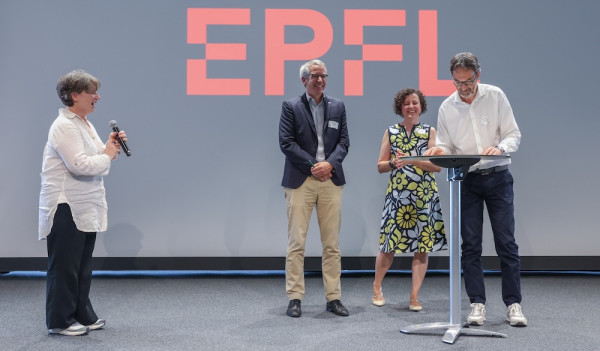
A highlight of the day came just before lunch with the formal signature of a collaboration agreement between CECAM and the Paul Scherrer Institute (PSI), represented by Andrea Cavalli, Barbara Montanari and Christian Rüegg. The agreement reinforces the shared commitment of leading European research organizations to strengthen scientific cooperation and support the computational science community.
© Alain Herzog/EPFL
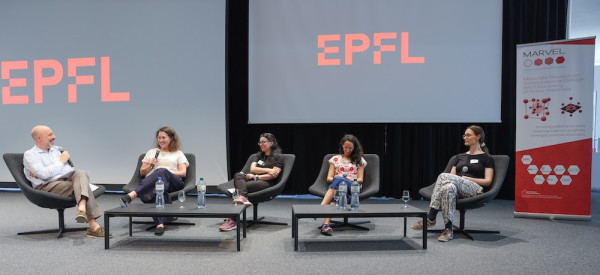
The afternoon opened with a round-table discussion on The future of materials, moderated by science journalist Nicola Nosengo (EPFL). Bringing together perspectives from academia and industry, the panel featured Raffaela Cabriolu (Norwegian University of Science and Technology), Ganna (Anya) Gryn'ova (University of Birmingham), Giulia Mangione (Stellantis) and Senja Barthel (Vrije Universiteit Amsterdam). The discussion explored emerging research directions, the growing importance of interdisciplinary collaboration and the skills required to prepare the next generation of materials scientists.
Machine learning remained at the heart of the following session, chaired by Michele Ceriotti (EPFL). Jigyasa Nigam (MIT) described the rapid evolution of atomistic machine learning and its transformative impact on computational materials science. Philippe Schwaller (EPFL) presented new approaches for the sample-efficient design of molecules and materials, bringing computational predictions closer to experimental synthesis. Sandip De (BASF) concluded the session by illustrating how machine learning is accelerating catalyst innovation through the integration of high-throughput computation and experimental validation, highlighting the increasing role of AI in industrial research.
© Alain Herzog/EPFL
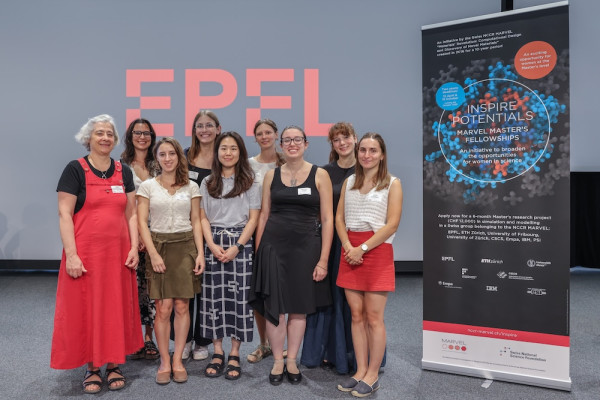
Current and former INSPIRE Potentials fellows. © Alain Herzog/EPFL
The conference concluded with a session dedicated to the growth of the materials simulation community itself. Chaired by Sara Bonella (EPFL), it emphasized that scientific excellence depends not only on technological advances but also on strong networks of people. Barbara Montanari (STFC Scientific Computing) reflected on how AI is transforming research communities while reinforcing the importance of collaboration and shared knowledge. Garu Gebreyesus (University of Ghana) offered a personal perspective on building electronic-structure research across sub-Saharan Africa through the various editions of the ASESMA School. Finally, Leopold Talirz (SCHOTT) presented Project GlasAgent, demonstrating how collaborative, agent-based approaches can support innovation in glass development.
In the end it was hard not to agree with what Garu Gebreyesus wrote in their slides: “sustained investment in people builds lasting scientific communities”, and the investment in MARVEL definitely built one.
© Alain Herzog/EPFL