New Open-Source Tool Simplifies Complex Phonon Simulations
By Nicola Nosengo - MARVEL
From superconductivity to optical properties, from phase transitions to heat and charge transport, many properties of materials that are important for commercial applications depend on the way their atoms vibrate in synch with each other. Physicists call these collective vibration phonons, and consider them quasi-particles: they are not actual particles, but they behave like them, and can be described by the same laws of quantum mechanics that apply to neutrons or electrons.
Understanding these vibrations is essential for the development of next-generation materials used in electronics, energy, quantum technologies, and scientists want to use the laws of physics to predict and explain phonon behavior in new materials even before doing experiments. But this becomes increasingly difficult for complex materials where there are many interactions between atoms, and where vibrations are highly chaotic – or, to use a more precise term, anharmonic.
MARVEL researchers have unveiled Pheasy, a new open-source computational platform designed to make advanced simulations of atomic vibrations in crystalline materials more accurate, efficient, and accessible. The software is described in npj Computational Materials.
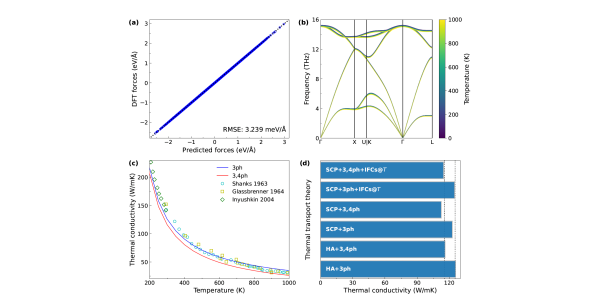
Anharmonic lattice dynamics and thermal transport in bulk silicon. Adapted from https://doi.org/10.1038/s41524-026-02163-1
Traditional methods for simulating phonons rely on calculating interatomic force constants (IFCs), which describe how atoms interact as they move away from their equilibrium positions. While these techniques work well for relatively simple harmonic and low-order anharmonic interactions, they become computationally prohibitive as researchers attempt to include more complex systems. The number of parameters grows exponentially, making calculations increasingly expensive and, in many cases, practically impossible.
The Pheasy code overcomes this limitation by combining first-principles calculations based on Density Functional Theory with machine-learning algorithms. The software reconstructs the potential energy surface of crystalline solids through high-order cluster expansions – mathematical tools that allow to approximate complex, non-linear functions into simpler and manageable equations. The authors further integrate machine learning algorithms to automatically select the most physically meaningful interaction terms while suppressing irrelevant ones, thereby enabling the extraction of reliable IFCs for most materials at a significantly reduced computational cost. The Pheasy code also provides recipes to create the right datasets for training Talyor-expanded lattice potential using machine learning algorithms for different classes of materials.
To demonstrate the software's capabilities, the research team applied Pheasy to three representative materials systems that highlight different aspects of anharmonic lattice dynamics and thermal transport: bulk silicon (the most commercially used and most well-known semiconductor), tungsten disulfide monolayer (one of the promising 2D semiconductors) and cubic strontium titanate (a member of perovskites, a class of materials with applications such as piezoelectricity, ferroelectricity and superconductivity). These studies showed that the software reliably reproduces complex physical behaviour while helping identify the most effective computational strategies for extracting high-quality interatomic force constants. Importantly, the authors also used these benchmarks to establish practical guidelines for researchers performing reliable lattice-dynamics simulations.
Notably, through a recent collaboration between researchers at MARVEL and the Lawrence Berkeley National Laboratory (LBNL), Pheasy has served as the core engine for the renowned Materials Project to build an extensive, high-throughput ab initio phonon database for inorganic crystals. It has computed harmonic phonon properties for more than 260,000 materials, bridging a critical knowledge gap in the vibrational properties of unknown materials.
As demand for materials with tailored thermal, mechanical, and electronic properties continues to grow, computational tools like Pheasy have the potential to accelerate the discovery and optimisation of novel materials by enabling researchers to explore complex phonon-mediated physical phenomena that were previously too computationally demanding to investigate routinely.
“Looking ahead, the Pheasy project could be extended to compute high-order electron-phonon coupling, which is almost unexplored, within the same mathematical formalism” says Changpeng Lin, a scientist in Nicola Marzari’s laboratory at EPFL and the first author of the article. “It will be an important tool for high-throughput screening and machine learning of phonon-related properties in next-generation energy materials”.
Reference
Changpeng Lin, Jian Han, Ben Xu, and Nicola Marzari, First-principles phonon physics using the Pheasy code. npj Computational Materials (2026). https://doi.org/10.1038/s41524-026-02163-1