AiiDAlab: A software to accelerate research
Whether on a smartphone, tablet or PC – computer users like things to be convenient. Apps can be launched and configured with just a few clicks or taps on the screen, all with intuitive and appealing graphics. The AiiDAlab user interface has been developed as part of the mission of the National Center of Competence in Research (NCCR) MARVEL to ensure that researchers enjoy a similar level of convenience when running complex computer simulations or data analyses. This software has been developed by a team of researchers, coordinated by Empa researcher Carlo Pignedoli and Giovanni Pizzi from the Paul Scherrer Institute (PSI). The team has now demonstrated that AiiDAlab is capable of much more than originally planned and has described this in the journal RSC Digital Discovery.
AiiDAlab is based on the AiiDA software, which has been developed since 2014. “AiiDA is primarily a workflow manager,” explains Edan Bainglass, a postdoctoral researcher in Pizzi’s group. “This means that it relieves researchers of the time-consuming task of manually starting multiple simulation programs, coordinating them with one another and extracting the data.” Building on Pizzi's work, AiiDALab was then originally developed at Empa by Carlo Pignedoli, Aliaksandr Yakutovich and Ole Schütt. Thanks to the close collaboration among the teams of Empa and PSI, AiiDAlab has evolved into the success it is today.
“Our vision for AiiDAlab was, therefore, to create a more user-friendly interface for complex computer software, so that users can focus entirely on their research and thus gain new insights more quickly,” says Pizzi. Using a graphical user interface, researchers can select and configure the desired simulation software; AiiDAlab then takes care of the rest: preparing and running the simulations, evaluating the results and finally presenting them graphically.
The original target audience for AiiDAlab was materials researchers who need to carry out a large number of numerical simulations in their search for new materials with very specific properties. AiiDAlab made this possible even for researchers without specialist computer skills and was highly successful in materials science. However, in recent years, the researchers realized that their software could also be applied in many other fields.
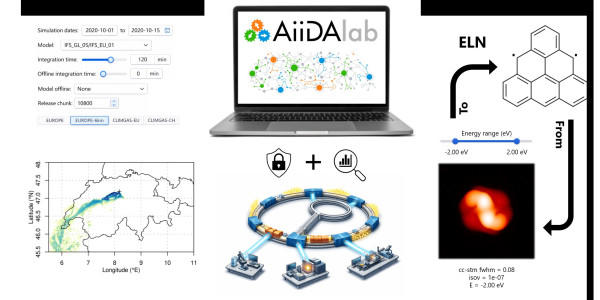
In their recently published paper, the researchers highlight a number of such applications, ranging from the simulation of the Earth’s atmosphere to battery development. At Empa, for example, atmospheric transport simulations controlled by AiiDAlab are being used by Stephan Henne and his team to quantify Swiss and European greenhouse gas emissions from atmospheric measurements. Empa also uses AiiDAlab for the automated characterization of batteries. “With AiiDAlab, we can track the behavior of batteries made from different material combinations over thousands of charge-discharge cycles,” says Corsin Battaglia, head of Empa's Materials for Energy Conversion lab.
The last example shows that AiiDAlab can coordinate not only simulations but also the execution and analysis of experiments. This capability is already being utilized at PSI, for example in the CAMEA neutron scattering experiment at the Swiss Spallation Neutron Source (SINQ). The main focus there is on supporting visiting researchers who are conducting their own experiments at PSI. AiiDAlab facilitates their access to the data storage at PSI, where the results of the experiments are saved. Some PSI experiments results might consist of very large amounts of data, and access to them is also protected by various security measures.
In the future, the researchers at Empa and PSI want to further expand the scope of AiiDAlab. “The original idea was to enable experimentalists to run routine ab initio simulations autonomously. AiiDAlab would not be what it is today without the constructive feedback we received from the experimentalists of the nanotech@surfaces laboratory. Thanks to the interest shown by other laboratories at Empa, including those of Corsin Battaglia and Stephan Henne, as well as by colleagues at PSI, AiiDAlab demonstrated its value well beyond its original scope,” says Carlo Pignedoli.
Reference
AV Yakutovich, D Hollas, E Bainglass, J Yu, C Battaglia, M Bonacci, L Fernandez Vilanova, S Henne, A Kaestner, M Kenzelmann, G Kimbell, J Lass, F Lopes, DG Mazzone, A Ortega-Guerrero, X Wang, N Marzari, CA Pignedoli and G Pizzi, Accelerating discovery across scientific disciplines through reproducible workflows with AiiDAlab, Digital Discovery (2026); DOI: 10.1039/D5DD00567A